I’ve always been prone to anxiety. Therapy has made me aware of what might have caused this and it’s helped somewhat. But my anxiety has persisted most of my life, albeit usually at a manageable level. No doubt I’m still well within what we accept as normal in society. Perhaps even a bit better adjusted than most.
However, a few years ago I began increasingly to fixate on our environmental crises – particularly threats to the biodiversity upon which humanity needs to survive. Threats that are driven by climate change and over-exploitation of what we like to call ‘natural resources’ but which we should more humbly refer to as our fellow creatures, plants, and other lifeforms who share our planet.
I remember watching documentaries in the 1970s and 1980s about ozone depletion and climate change. I couldn’t get my head around why, once the programme was over, no one seemed particularly concerned about these huge problems that might cause our extinction. The news just wasn’t covering it. There seemed to be a massive worldwide cognitive dissonance.
I became active in the environmental movement in my first year at university in 1989 when a friend first showed me the Green party’s manifesto. It blew me away. So I stood for election to Manchester city council for the Greens that same year with a slogan that said “ignoring it [i.e., climate change] won’t make it go away” illustrated by a wonderful cartoon drawn for our leaflet by Polyp.
Needless to say, I wasn’t elected. And, despite promises to the contrary, climate change was effectively ignored. Emissions of CO2 continued to grow relentlessly. It certainly didn’t go away. Now, of course, most people are familiar with its effects – truly catastrophic for the increasing numbers of people and wildlife affected. What had once been a distant, but still terrifying, prospect is now becoming manifest.
From around 2019, I began to experience full-on eco-anxiety. Thoughts of imminent environmental collapse were ever-present. I woke up with it. In particular, I became obsessed with drought. After a week or two without rain, I would scan weather forecasts for when the dry spell might end and feel disconcerted when I saw no prospect of this happening. Rain drops on my BBC weather app scheduled for the next week would evaporate as we got closer. When I met people remarking how wonderful the weather was, I felt utter dismay and concluded that they must be living in denial.
Around a year ago, in autumn 2022, I watched an interview with Jeffrey Martin. In it, he described research in which he had interviewed people who had experienced a spiritual awakening. Despite coming from many different spiritual traditions and none, they shared many common features. In particular, those of them who had deliberately arrived at that state described how they got there through forms of meditation and other practices. Jeffrey Martin distilled the most effective elements into a 45 day course which promised more or less to guarantee awakening for anyone who took part.
I’ve been practising meditation on and off for around 35 years (starting with Transcendental Meditation and then Deepak Chopra’s similar system), ever since someone recommended it to me as a way to address panic attacks. It’s been an amazing tool. It’s helped to keep my stress in check. But I don’t believe it ever induced any level of ‘spiritual awakening’.
The course wasn’t cheap and I didn’t like its pushy marketing. But I took the plunge anyway. It was fairly intense. There were videos to watch that showed how to perform at least one new method each week and we had to meditate for a full hour every day as well as perform practices morning and evening. This was far more than I was used to. I also really disliked some of the meditation techniques (especially one involving scanning every part of my body one square inch at a time).
What’s more, I discovered that the course’s definition of ‘awakening’ was somewhat unconventional. Jeffrey Martin suggests that there are at least five levels of ‘fundamental wellbeing’, which is what they call awakening. Level 3 is the one we might recognise from standard definitions. This is the one that’s described in spiritual traditions and by various people who claim to live in a state of ‘enlightenment’. Level 3 includes feelings of oneness, bliss, radiance, auras, synchronicities, and the like. However, levels 1 and 2 are more subtle. These mostly involve a feeling that ‘deep down’ everything is fundamentally OK. Hence fundamental wellbeing. These entry levels don’t include the kinds of treats in store for level 3-ers. Every level is known as ‘awakening’ and is what the course virtually guarantees almost all participants.
This really annoyed me at first. It felt like a con. But eventually, I came to have a slightly different perspective.
Before and after the course we had taken mandatory – and extensive – standard psychometric tests to measure well-being. I was very sceptical that these would measure anything at all. Surely I’d just remember what I put when I took them a second time? However, I was pretty amazed to discover that my well-being had indeed seemed to increase significantly over the course even though subjectively I felt the same. For example, the time I reported feeling happy had risen from 40% to 90%, my satisfaction with life indicator from 17 to 25, and so on. I was assessed as achieving fundamental wellbeing level 1. With a little time and reflection, I realised that I did feel much better. It was subtle, but it was real. And it was profound.
A year on, I can report that this has persisted. I do indeed have a sense of fundamental well-being. Deep down I feel that – no matter what happens – I will be OK. My eco-anxiety has – amazingly – vanished. It’s transformative. I no longer obsess about the state of the world. Does this mean I’m in denial of the deep shit we’re in as a species? Of course not – my brain has not been washed. However, I’m far more aware of how many people, governments, and businesses are genuinely working to stop and reverse the damage we’re doing to our home. And I believe we are getting there, despite the best efforts of the fossil fuel industry and short-sighted politicians.
I no longer subscribe to patterns of thought like Deep Adaptation, a fatalistic system I now believe could be as problematic as climate denial, albeit in a less unhinged way. I realise that not only was my eco-anxiety not reflecting objective reality, it wasn’t helping anyone either. Certainly not me. And certainly not the world.
Most importantly, I realise that I am not responsible for what’s happening. I’ll continue to work on various forms of climate action, support excellent initiatives (such as this one and this one), and I ultimately believe that humanity needs to evolve spiritually and psychologically; however, I realise I only have very limited control over the future. In other words, my ego is more in check.
I now spend less time on news headlines, which are after all designed to grab our attention, and more on what’s really going on. For this new framing I have to thank in particular Hannah Ritchie, Tony Seba, and Peter Fiekowsky. But I also owe a huge debt of gratitude to Jeffrey Martin and his team for the awakening course. I believe it was truly transformative for my life. Thank you.
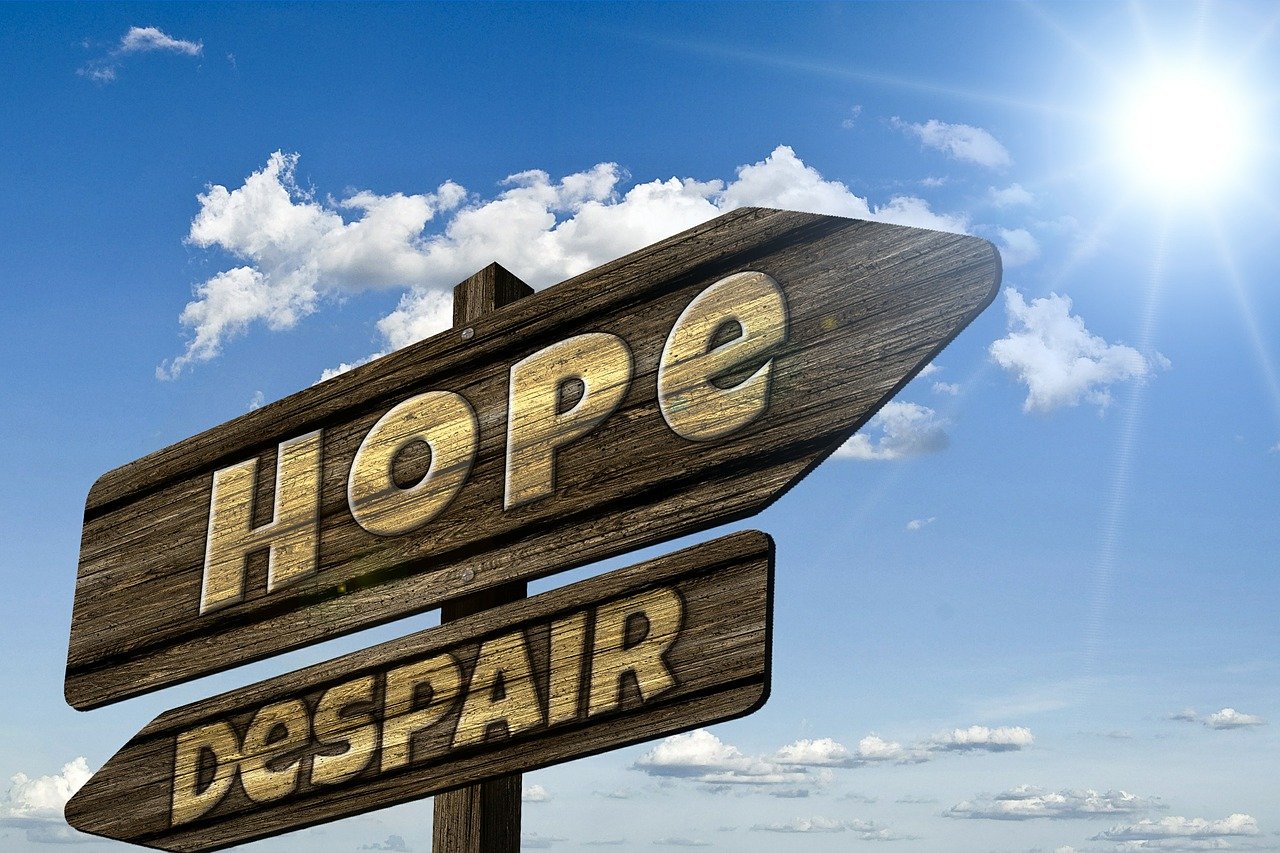
Featured image by Gerd Altmann from Pixabay