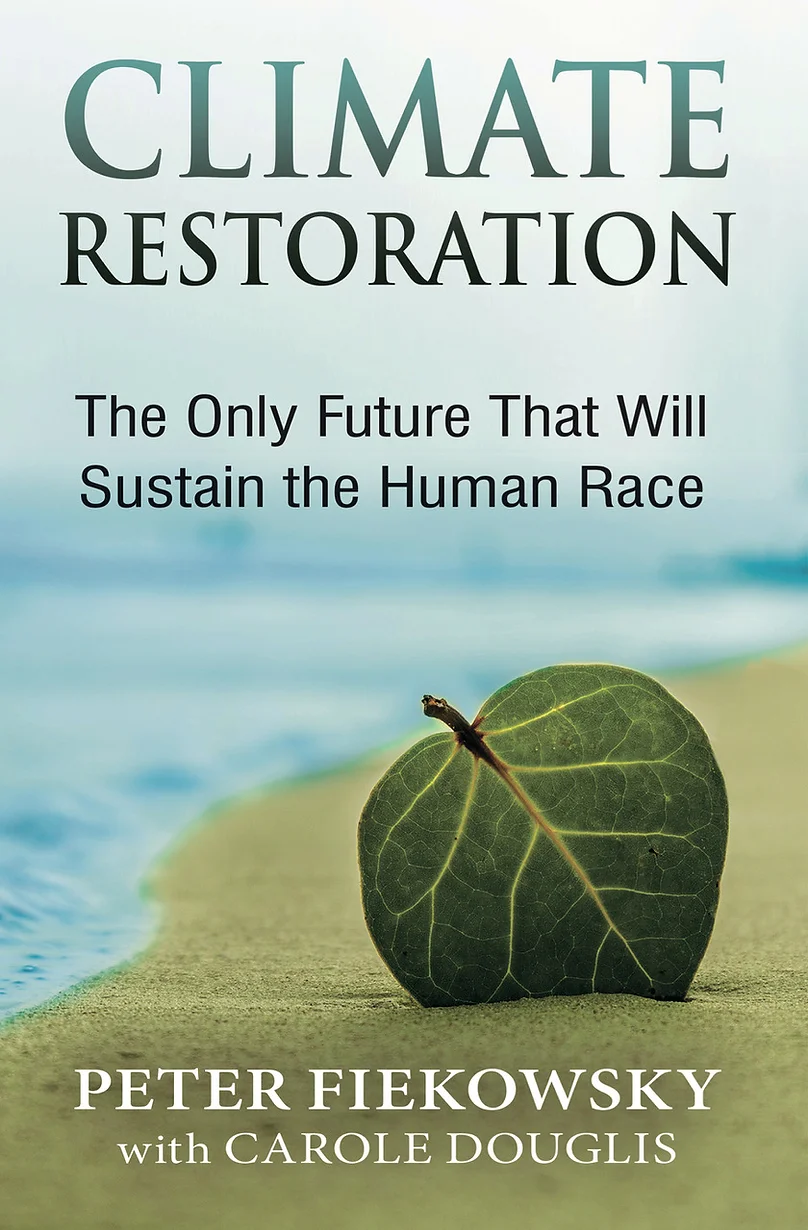
A review of Climate Restoration by Peter Fiekowsky and Carole Douglis
I don’t know about you, but it feels like humanity is finally getting serious about climate change. One prominent think tank suggests that global carbon emissions from electricity may start to fall this year owing to investments in renewable energy outstripping those in fossil fuels, and some people think that market forces could mean that we achieve net zero even earlier than 2050. Neither of which would be a moment too soon.
Despite these positive trends, climate change is becoming ever more present, leading to increasing instances of extreme weather around the world, including last summer’s record-breaking heatwave in the UK. And all of this is happening at current levels of greenhouse gases. CO2 levels will inevitably continue increasing as we change course. This will lead to more warming, more extreme weather, sea level rise, food shortages, among other nasty effects, and, perhaps most ominously, increasing potential for triggering calamitous tipping points.
Our Climate Action Ilkley book club recently discussed Climate Restoration. Its main author, Peter Fiekowsky, estimates that by the time we finally stop emitting CO2, say in 2050, this gas will constitute around 460 parts per million (ppm) of the atmosphere. This is two-thirds higher than the pre-industrial average of 280ppm. Given what is already happening to our planet at current concentrations (around 420ppm), this could be catastrophic and is much higher than levels have been for almost the entire history of civilisation. In other words, the goals of the much-vaunted Paris Climate Accords are woefully insufficient and would leave us in very dangerous uncharted waters.
The main thrust of the book is that we should work to restore the atmosphere to comprise around 300ppm of CO2 in order to allow a viable future for our species. This suggestion of actually reducing the concentration of greenhouse gases below what they are now does not often feature in discussions about climate action. In one sense, this is understandable given that our immediate focus is to stop burning stuff. But it’s also possibly suicidal. What doesn’t help matters is the understandable suspicion on the part of some environmentalists that any talk of removing carbon is – at best – a distraction from the urgent need to transition our societies away from fossil fuels and – at worst – a ruse by Big Oil to continue business as normal.
As well as arguing that this is a form of denialism, Fiekowsky also asserts that viable solutions to suck carbon and methane out of the air already exist, albeit in nascent form. The focus of the book is on the four technologies Fiekowsky considers to be the most promising.
The first of these is synthetic limestone manufacture – literally making limestone from captured CO2. Limestone is a key ingredient in concrete. If we built using this stuff instead of digging for natural limestone it could transform the massive construction industry from being carbon-intensive to carbon-negative. One US company is already seeking to scale up this process.
The second is seaweed permaculture. This involves replenishing the oceans with kelp and other seaweed. Not only would this draw down immense amounts of CO2, this would also provide rewilded habitats for fish and other sea creatures. Kelp is used as a key ingredient in a range of consumer products like toothpaste and cakes so this has potential to become self-financing. Again, moves are already afoot to make this a reality via organisations like the Climate Foundation.
The idea of the third technology is to seed barren parts of the ocean with iron in order to feed phytoplankton. This is known as ocean iron fertilisation and the process mimics what happens naturally via dust storms and volcanoes. Phytoplankton (which are microalgae) constitute the bottom of the food chain and also pull CO2 from the atmosphere via photosynthesis. As these organisms, and the animals that eat them, die, their bodies, loaded with carbon, drop to the ocean floor. Not only is this idea is highly controversial – it was tried without authorisation in 2012 – it may not work. However, research is ongoing, not least championed by Sir David King, formerly the UK government’s chief scientific advisor.
The final technology is not about carbon at all. Its focus is methane, a gas that is over a hundred times more powerful than CO2 in terms of warming. What is incredibly frightening is that one of the dangerous tipping points that we may trigger from climate change – and possibly soon – is a large-scale methane release from melting (apparently not-so) permafrost in the Arctic. A similar event happened 56 million years ago and may have caused a mass extinction of 30% of the species then alive. The technology proposed as a potential solution is to oxidise methane over the ocean, speeding up a natural process. This could provide an insurance policy against a large methane burst but, intriguingly, also has the capacity to reduce methane in the atmosphere to pre-industrial levels relatively quickly. This would effectively reverse global warming back to 2005 levels buying us time to complete our transition away from fossil fuels and scale up other removal solutions. This organisation is among those working towards a variety of solutions for methane removal.
This book has opened my eyes to the entrepreneurs and scientists who are focused on making carbon removal a reality. Reading it has prompted me to dive into any number of online rabbit holes, such as learning about the interim winners of the Musk Foundation’s $100m XPRIZE for carbon removal, and seeing what happens when companies at the cutting edge of this mission don’t fully engage with local communities, for example, in Cornwall. I feel energised to learn more and might even start to lend a hand. The bottom line is that I would very much recommend this book, even if much more work needs to go into research and development of all of the technologies we deploy. It’s a hopeful vision and makes a persuasive case that net zero is only a starting point for humanity on the road to a truly sustainable future. This is a conversation that needs to be had.